What design tools taught us, why they're disappearing, and what comes next.
Figma launched in 2016 and changed everything. It was browser-based, real-time and collaborative, and it replaced the clunky, file-on-your-hard-drive tools designers had been fighting with for years.
Its real breakthrough wasn’t a drawing tool. It was multiplayer: designers, product managers and engineers in the same file, at the same time. Design stopped being a handoff and became a shared workspace.
If you worked in product design between 2017 and 2023, knowing Figma deeply was a career skill. It was the tool that separated designers who knew what they were doing from designers who didn’t.
In September 2022, Adobe announced it would acquire Figma for roughly $20 billion, one of the largest software acquisitions ever announced. Fifteen months later the deal was dead. Facing objections from regulators in the UK and the European Union, the two companies called it off in December 2023,1 and Adobe paid Figma a $1 billion termination fee.2
Adobe had decades of dominance with Photoshop and Illustrator, and its own Figma competitor in XD, and still felt the need to spend $20 billion to neutralize a startup. After the deal collapsed, Adobe said it had no plans to invest further in XD.3
Figma went public on its own instead, pricing its IPO at $33 a share in July 20254 and soaring on its first day of trading. Then the line started to bend the other way.
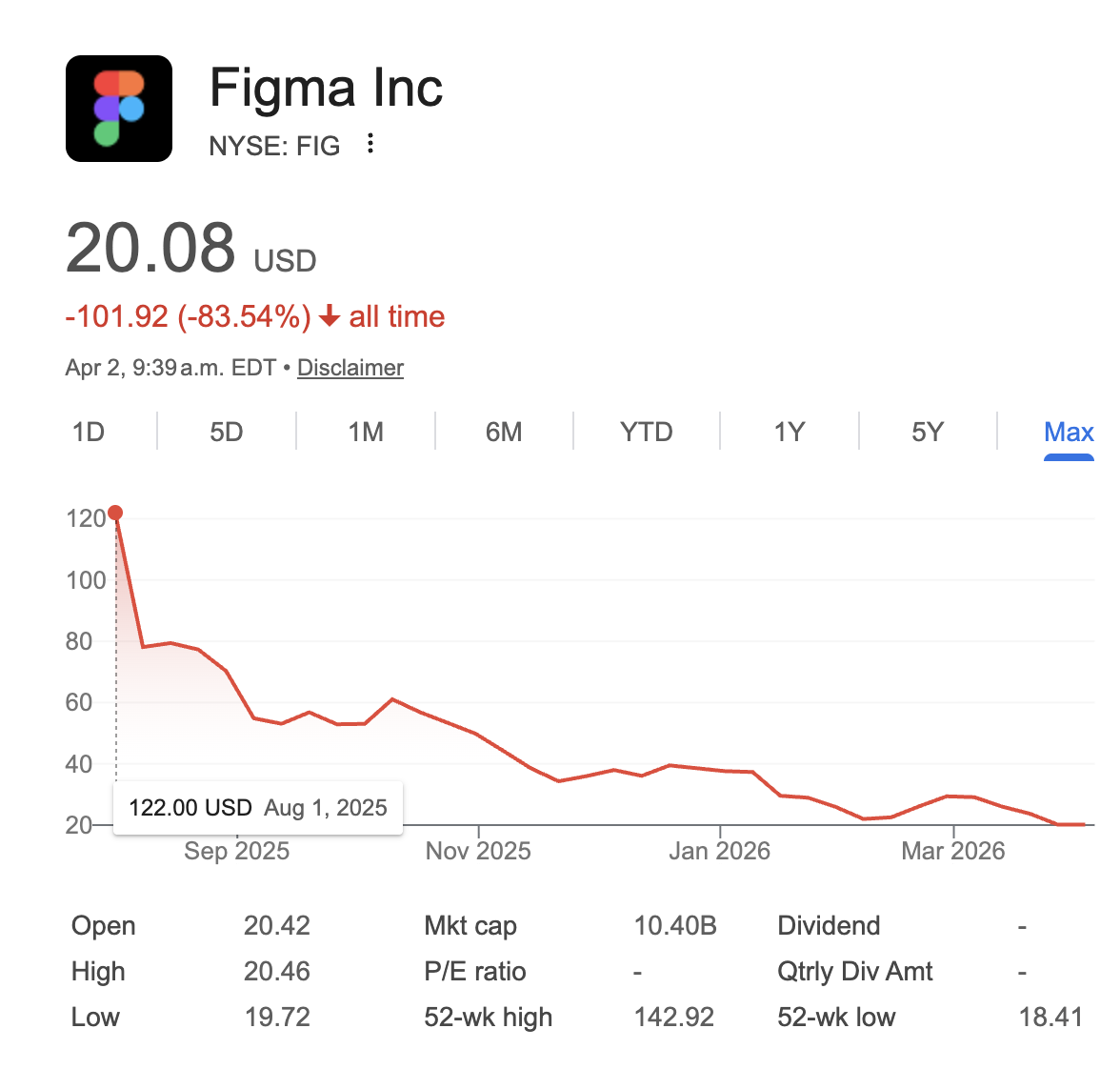
BUT the real threat to Figma was never Adobe. It was something else entirely.
The thing Adobe couldn't buy its way out of.
For most of a decade, the threat to a design tool was another design tool. Over the last eighteen months, the threat stopped being a tool at all.
Read that last line again. The business was growing. The market was pricing in what comes next.
Here are two things I've shipped at RVezy that didn't exist in a designer's toolkit two years ago.
Our email production workflow was: design in Figma, export with Emailify (the worst plugin ever built), hand off to Braze, fix everything that broke.
In just a few days I built an internal Next.js tool that replaced the entire chain. Pick a template, configure blocks, preview in dark and light mode, and copy the HTML. No Figma. No code.
→ Live DemoI built an AI-powered Figma plugin that generates production-ready Vue and Tailwind components pulled directly from our design system.
The brain behind it is those two files: the design system doc and the color registry. The plugin is just the hands.
# RVezy Design System v2.0 # Vue 3 + Tailwind CSS v4 ## Button Variants: default | highlight | secondary Sizes: sm (h-9) | md (h-11) | lg (h-13) Always: rounded-full, border-2, font-semibold default: bg-primary-950 text-white highlight: bg-secondary text-white secondary: bg-white text-primary-950 ## Badge success: bg-green-100 text-green-700 warning: bg-orange-100 text-orange-700 error: bg-red-100 text-red-700
// Brand colors as RGB values // readable by any tool or model "primary": { "500": { "r": 0.184, "g": 0.706, "b": 1.0 }, "600": { "r": 0.153, "g": 0.427, "b": 0.973 }, "950": { "r": 0.075, "g": 0.145, "b": 0.345 } }, "semantic": { "secondary": { "r": 0.153, "g": 0.427, "b": 0.973 }, "white": { "r": 1.0, "g": 1.0, "b": 1.0 }, "black": { "r": 0.0, "g": 0.0, "b": 0.0 } }
Two years ago, every idea I had started as a rectangle on a Figma canvas. Today, by the time I open Figma, the idea has already been explored, built in real code and tested against real data. This is the toolkit I reach for first, and the one I’d expect any senior designer to be fluent in.
Before I design anything, I decide what it’s made of. Tailwind gives design and engineering one shared vocabulary of tokens, spacing and type. shadcn/ui gives me accessible, well-built primitives to compose from, instead of redrawing buttons from scratch.
This is where ideas are born now. I describe the problem, not the pixels, and get several genuinely different directions in minutes, from layouts to clickable prototypes I can critique.109 The tools generate; my job is knowing which direction is right, and why.
The fastest way to end a debate is a working prototype. With Claude Code I build the idea against our real codebase and real data, so I’m testing behaviour and edge cases, not a picture of them.6 For quick standalone experiments, v0 turns a prompt into a React and shadcn/ui prototype.12 This page, and the site it lives on, were built the same way.
Figma is still in the workflow. It’s where I refine the craft, document decisions and align the team. Tellingly, Figma is moving the same way: Figma Make turns prompts into working prototypes.7
Figma is still there. It’s just no longer where ideas are born. It’s where they’re finished.
A designer's career has historically been built on being very good at specific software: Figma, Photoshop before that, XD in between.
So when I say Figma is losing relevance, I'm saying it as someone whose identity was tied to it.
The designers who are thriving right now aren't the ones who resisted these tools. They're the ones who recognized what actually made them good in the first place. It was never really about the software.
AI can generate a UI in seconds, but it cannot tell you whether that UI respects your user. That part still requires a human.
In a world flooded with AI-generated interfaces, taste is becoming rarer and more valuable, not less. I'm not watching this shift from the outside. I'm building inside it, at RVezy, every day.
Research compiled October 2026. Market figures as reported at time of publication.